The Third-Man Run: Why the Best Pass Can Be the One Before It
Understand the third-man run in soccer: spot the support movement that helps a team pass beyond pressure and see why the setup pass matters.
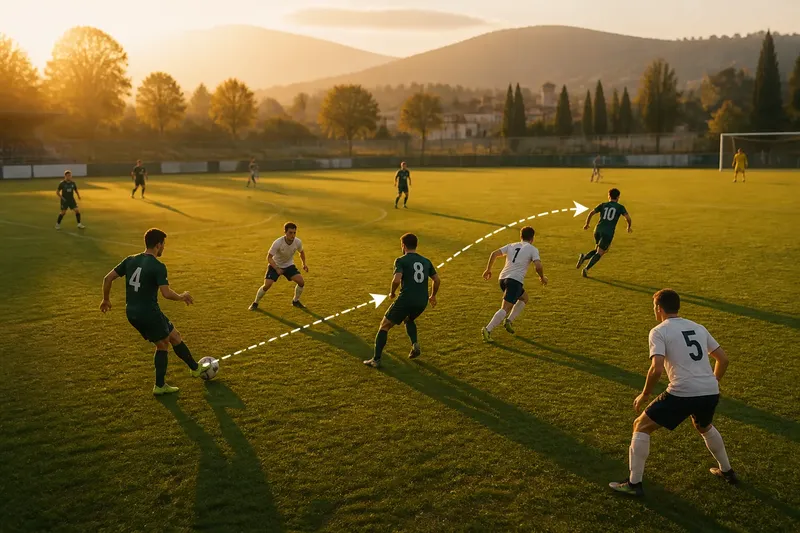
The third-man run in soccer turns a crowded patch of grass into a route forward. One player passes to a teammate, that teammate redirects the ball, and a third player moves to receive beyond the pressure. The runner may never touch the opening pass. Their movement is still the point: it gives the team a way through a defender focused on the ball.
Watch the player nearest the ball, then look one link farther away. If that teammate receives with a defender closing while a runner moves into space behind or beside the defender, the team may be building a third-man combination. The simple-looking pass can set the whole route in motion.
The three-player route
The name describes a relationship, not a fixed position or a rehearsed trick. The first player has the ball. The second offers a passing option and becomes a temporary link. The third moves to receive the next pass, often facing forward or arriving in a pocket the opponent has left open.
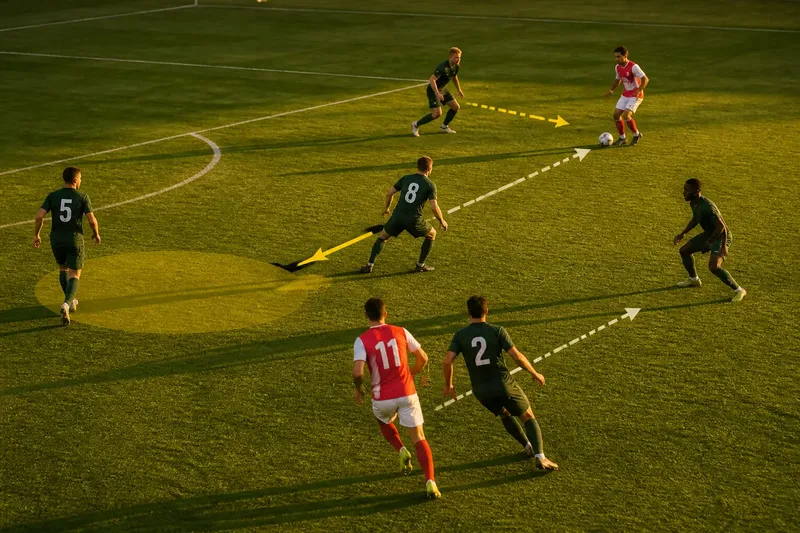
Imagine a center back carrying the ball toward a forward who has dropped short. A midfielder starts a diagonal run behind the forward’s marker. The center back passes to the forward; the forward cushions the ball into the midfielder’s path; the midfielder receives beyond the first line of pressure. The visible result is a teammate emerging with the ball in space while the defender who pressed the forward is left behind the play.
The same route can involve different players and different parts of the field. A fullback might be the first passer, a winger the link, and an advancing midfielder the runner. Or a midfielder may feed a striker who lays the ball off for another midfielder. The roles are temporary. What matters is the sequence: pass, link, run, release.
Why the link matters
A defender can close the player with the ball and block a direct pass to the runner at the same time. The teammate in between changes the angle. Instead of threading a difficult ball through the defender’s path, the first passer finds someone who can redirect it around the pressure.
The link player also gives the first passer a useful target. A forward who checks toward the ball can draw a center back or occupy a holding midfielder. That movement may open a lane behind the defender for the runner. The link does not need to turn or beat an opponent; a one-touch layoff can be enough to change the picture.
The pass before the forward pass can carry more tactical weight than it seems. It invites pressure toward one spot, changes the ball’s angle, and gives the runner a moment to attack space the pressure has vacated. If the first pass is slow or the receiver must stop the ball under a tight challenge, that moment can disappear.
Read the supporting movement
To spot the pattern, do not follow the ball alone. Start with the player who might become the link, then scan for the teammate moving as the ball travels. The runner’s first steps often begin before the link player receives. That timing lets the runner arrive with momentum rather than wait for a pass while marked.
- Check the first passer’s body shape. If the player is open to both the short option and a route farther forward, then watch for a pass that can start either route; if they are closed off, expect a safer reset or another touch to change the angle.
- Watch the link player’s marker. If an opponent follows the link toward the ball, then scan behind or beside that defender for the runner; if the defender holds position, look for the link player to turn or pass elsewhere.
- Track where the runner starts. If the runner steps away before darting toward the gap, then check whether that creates separation; if the marker stays tight, the runner may need to change direction or draw the marker away from another lane.
- Check the receiving angle. If the runner approaches diagonally with a clear path to the link player, then expect a possible release; if a defender blocks that angle, the link can retain possession or find a different teammate.
- Follow the runner’s first touch. If it takes the ball into open space, then the pass has carried the move forward; if it points back toward pressure, the lane may have closed, so the receiver can protect the ball or return it.
- Notice the timing. If the runner starts as the ball travels to the link, then look for a pass before the defense recovers; if the run begins too early and is tracked, the link can keep the ball and use the space elsewhere.
The most revealing moment may come before the ball reaches the link. If the runner moves too early, a defender can track the run and intercept the obvious pass. If the runner waits until the link has the ball, the defender may recover. Good supporting movement stays connected to the ball’s travel without becoming a predictable sprint.
When the route changes?
Does the third man always run forward?
No. The third player may move laterally or toward the ball to escape a tight mark and offer a new angle. The useful feature is that the movement helps the team play around pressure, not that it always gains ground immediately.
Can the link player keep the ball?
Yes. If the defender does not close the link player, they may turn and carry the ball rather than lay it off. The third-man run still matters because it can occupy a marker or make the opponent protect the space behind.
What if the runner is marked?
The run can still create value by pulling a defender away from another teammate’s route. The first passer or link player may then use the space that opens rather than force a pass into a covered lane.
How is this different from a one-two?
A one-two usually describes two players exchanging passes, with one returning the ball to the other. A third-man combination involves a third player receiving the next pass, even if the first two players’ movements resemble a familiar give-and-go.
Timing beats choreography
The pattern is not a command to pass forward at any cost. The link player has to judge whether the runner is free, whether the pass can be played cleanly, and whether the opponent has closed the route. A safe return pass can be right if the lane is blocked. Forcing the intended combination turns an advantage into a turnover.
The first passer’s decision matters too. A crisp pass can reach the link before the defender arrives, while a ball behind the receiver may require a settling touch and slow the move. The link player’s body position shapes the next option: a half-turn may reveal the runner, while a closed stance may favor a quick layoff.
The runner has choices as well. They can curve around a defender, hold their position to stay onside, or pause briefly to let the passing lane open. The best route is not always the shortest. A curved run can keep the runner in view of the link player and approach the ball at a useful angle.
When the route is blocked
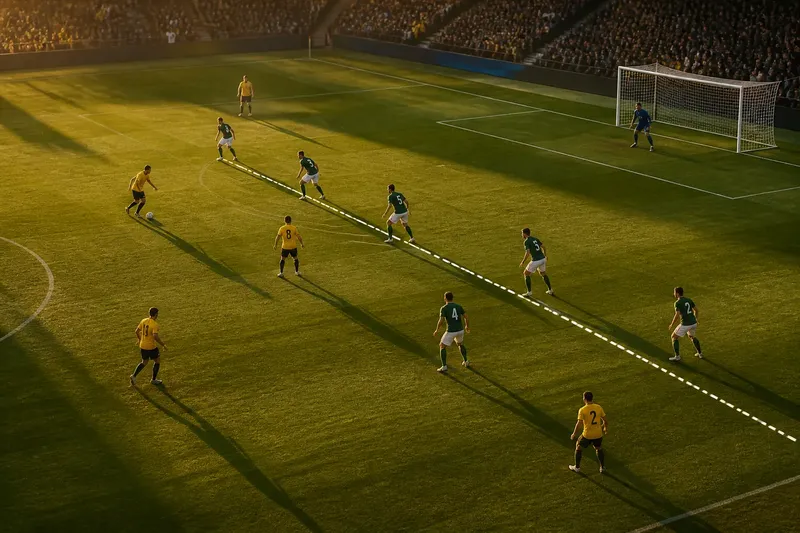
Defenders can disrupt the sequence by staying goal-side of the runner, refusing to follow the link too far, or pressing the receiver so tightly that no clean layoff is available. A compact opponent may leave no useful space beyond the first line. In those moments, the attacking team can recycle possession, switch play, or use a different combination.
For the viewer, a failed third-man attempt is still worth reading. Ask which part broke down. Did the link receive with a defender on their back? Did the runner start before the lane existed? Did the first pass reveal the intention too early? Those clues distinguish poor execution from a sensible idea the defense anticipated.
It is not worth labeling every quick exchange a third-man run. If no distinct third player moves to receive or create space, the label adds little. Focus on the relationship between the pass, the link, and the supporting movement; the pattern is clearer when those roles are visible.
From glimpse to pattern
One successful combination can look improvised. Repeated movements reveal a team’s habits: a striker checking short as a midfielder runs beyond, a winger receiving inside as a fullback overlaps, or a central player setting the ball for a teammate arriving from depth. The same basic route can help escape a press or enter the space outside the penalty area.
Say you are watching a center back pass into a forward near the touchline. The forward’s marker follows, while a midfielder begins a diagonal run into the gap. If the forward lays the ball into that path and the midfielder receives facing upfield, you have seen the pass, link, and third-man movement work together. If the marker instead blocks the lane, the forward can return the ball to the center back, leaving the team in possession rather than forcing a pass.
Next time a team plays into a marked teammate, find the player moving beyond the receiver, then trace the first pass that made the move possible. That is the third-man run in soccer: not simply a forward sprint, but a coordinated way to turn a teammate into a temporary bridge through pressure.