False Nine or Target Forward: Two Different Jobs at the Centre
False nine or target forward: learn how each role changes passing links, defensive attention, and the space teammates can attack during a match.

A false nine or target forward changes where a defense must look. The difference becomes clear in the next pass: who receives it, who runs beyond, and which defender has to choose between stepping out and holding position?
Imagine a hypothetical match in which a team has possession near halfway, but its central striker keeps getting crowded by two center backs. The coach first uses a forward who drops toward midfield, then switches to a high target who stays close to the defenders. The ball and teammates remain the same; the striker’s changing job creates two different routes into attack.
The starting problem
The team’s usual shape has two wide attackers, an attacking midfielder, and a central forward. The midfield can circulate the ball, but the forward rarely receives facing goal. If he stays high, the center backs can keep him between them and the goalkeeper. If he comes short, the next pass often finds him with his back to pressure and no nearby runner.
The choice is not simply about finding a better striker. It is about what the team needs the central player to do with the defenders’ attention. A dropping forward can tempt a center back out and create room behind. A high target can pin the defenders, offer a direct outlet, and give teammates time to move up. Either solution depends on the players around him recognizing the invitation.
For the first part of this invented situation, the coach chooses a false nine. The role is not a permanent address or a special kind of player. It describes a forward who repeatedly leaves the highest line to receive between midfield and defense. He must connect play and make defenders decide whether to follow.
The false nine’s invitation
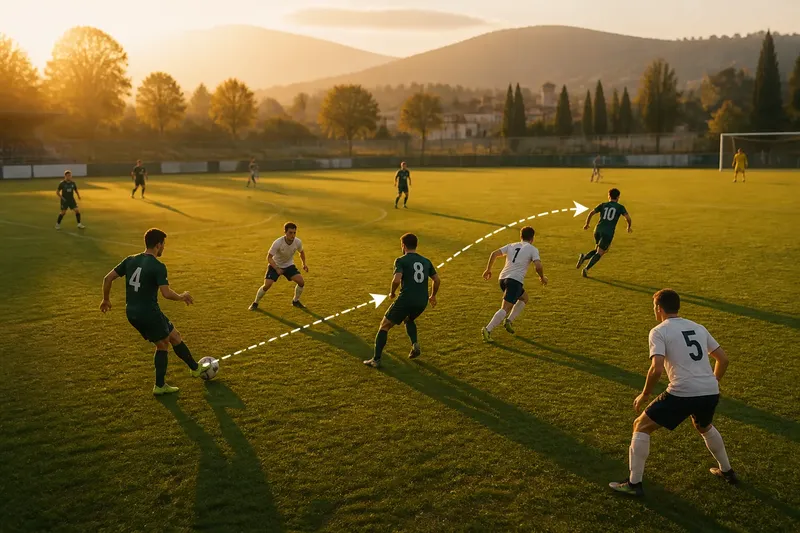
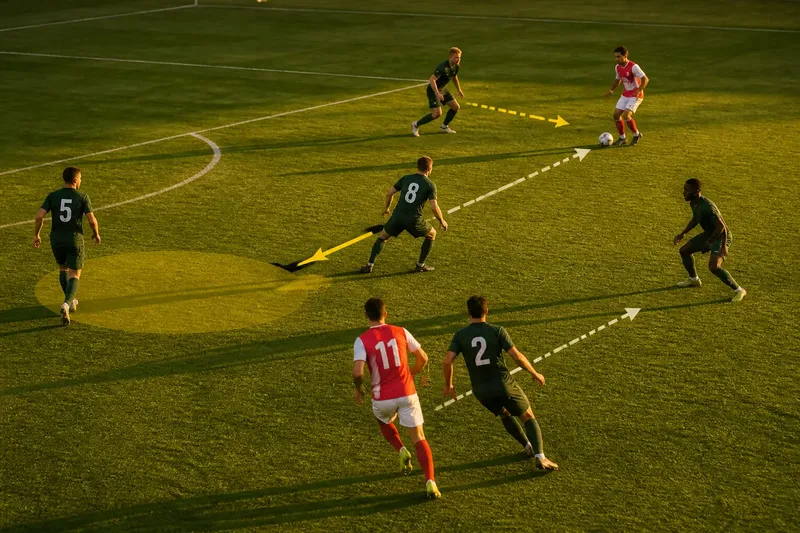
The striker drops toward the attacking midfielder just as the left winger moves inward. An opposing center back steps forward to stay close. That opens a lane behind him, but the lane matters only if someone attacks it. The winger accelerates into the space while the right winger stays wide and stretches the other side of the back line.
The midfielder can pass into the forward’s feet, switch to the wide player, or find the runner beyond the stepping defender. The false nine adds a connection in the middle. He may turn, lay the ball off, or draw a marker and let another player take the next touch. His influence can be clear even when the ball moves elsewhere.
In the invented sequence, the striker receives with his back to goal and returns a short pass to the attacking midfielder. The left winger has already run beyond the center back, so the midfielder sends the ball into that channel. The move reaches the box, but the final pass is cut out. The result is a route into space that had been closed while the striker stayed high, not a goal.
This approach depends on timing and proximity. If the forward drops but the wingers remain still, several players may ask for the ball in front of the defense while nobody threatens its back. If both wide attackers run inside at once, the attack can become cramped. The false nine creates a question; teammates must answer with complementary runs.
The target forward’s platform
Now imagine the coach switches to a target forward. He remains high, near the center backs, and offers a pass through or over midfield. “Target” does not mean he must win every aerial duel. Useful traits may include shielding the ball, judging a bouncing pass, occupying defenders, or laying a simple pass into a teammate’s path.
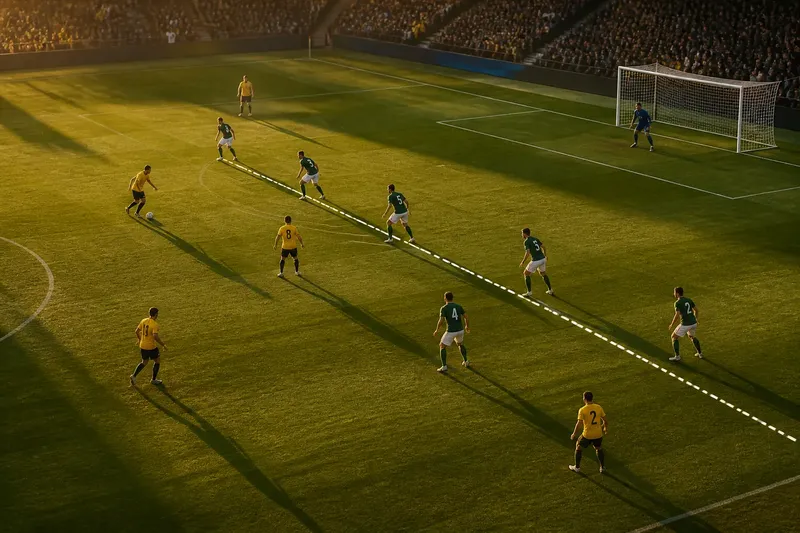
As the forward holds his position, the center backs have less reason to step toward midfield. That can leave room in front of them for the attacking midfielder to receive. Wide players can stay available for switches, while a midfielder advances to support the striker’s first touch. A high target can connect a direct pass to the next phase rather than simply end a move with a contested ball.
In the invented match, the team sends a firm pass toward the target forward’s chest. He cushions it back to the attacking midfielder, who has moved close enough to collect. The left winger runs beyond the fullback as the midfielder turns, while the right winger remains wide. The team advances through a direct connection, and the striker’s hold-up play brings support into the attack.
The same pass can fail if support arrives late. The forward may be surrounded, forced to contest the ball alone, or left without a safe layoff. A high target also cannot create depth by dropping into midfield every time possession stalls; that gives the center backs permission to step forward. Part of the role’s value is staying high long enough for teammates to use the space around him.
Reading each role?
What does a false nine do?
A false nine drops from the front line to receive among opposing midfielders or between the lines. The movement can pull a defender forward and open space for a winger or attacking midfielder to run beyond.
What does a target forward do?
A target forward stays high as an option for direct passes and tries to secure or redirect the ball under pressure. Teammates need to move close enough to collect the layoff or attack the second ball.
Can one player perform both roles?
Some forwards can vary their movement, but the roles ask for different positioning at key moments. Ask what the team needs in that phase: an extra receiver between the lines or a high outlet that occupies the center backs.
How can you tell which role is working?
Watch what happens after the forward moves, not just where he stands. A dropping striker helps if teammates reach the space he opens; a high target helps if the team can connect his first touch to support or territory.
The defensive adjustment
In this hypothetical match, the opposition adjusts after the false nine’s drop-and-run pattern starts opening the central channel. A midfielder tracks the striker instead of asking a center back to step out. That blocks the easy pass into the forward, but it leaves fewer midfielders near the target area. The coach switches to the high target, seeking a different connection rather than repeating a route the defense has read.
The next attack starts with a direct ball into the striker. He cannot turn, but he holds off the defender long enough to lay the ball toward the advancing midfielder. The midfielder sends it wide, and the winger crosses before the defense can settle. A defender clears the delivery. The move does not produce a goal, but it carries the team forward and forces the opposition to defend facing its own goal.
The distinction lies in the space each job can open. When a false nine drops, the space behind the defense may become a runway for runners. When a target forward stays high, space in front of the defense may open for a midfielder, while the striker remains available as an outlet. Neither space is useful by itself; a teammate must reach it at the right moment.
Signals around the striker
For the false nine, watch the relationship between the drop and the next forward run. If the striker comes short and nobody attacks the line, the team has gained a receiver but surrendered depth. If a defender follows and a winger darts behind, the movement has altered the defensive shape even if the ball never reaches the runner.
For the target forward, watch the distance to the nearest support. A clean first touch is only part of the job. A midfielder or wide player must be ready to receive the layoff, while other attackers stay positioned to stretch the defense. Without those connections, a direct pass can return possession to the opposition.
It is not worth judging either role by goals alone or by a single touch. A false nine may make a teammate’s run possible without recording an assist. A target forward may keep an attack alive with a simple cushion pass that never appears in a highlight clip. Track the defenders’ choices and teammates’ responses instead.
When you watch a match, note the striker’s starting position, who moves toward him, and which teammate uses the space afterward. That sequence makes false nine or target forward easier to read: one role draws a defender away from the last line, while the other can hold that line and connect the team to it. The best fit is the one whose movement gives the players around him a clear next action.